
Airlines & Air Travel, Through a Queer & Pop Culture Lens
Now part of the permanent archives at the Museum of Flight
In the days before social media and blogs, fanzines (also known as 'zines) were a thriving creative platform for communication and creative expression. Skyjack Magazine, which I created, is a prime example: an unapologetically queer, unapologetically aviation-obsessed zine that took flight from 1993 to 1997 — a cheaply produced love letter to airlines, pop culture, insider gossip and the LGBTQ+ people who kept the industry aloft.
The fact that the Museum of Flight — the world's largest non-profit independent aviation museum — has added the full Skyjack archive to its permanent collection is proof that this is a true time capsule, offering a fascinating glimpse at often-overlooked aspects of the airline industry.
Created long before blogs, hashtags, or “content creators,” Skyjack mixed camp, candor and cultural critique with reports from real pilots and flight attendants, celebrity interviews (hello, RuPaul), deep dives into airline history and a healthy dose of irreverent humor at 35,000 feet. Digitized for the first time, these issues offer a time capsule of 1990s queer travel culture — and proof that even in the jet age, soaring above the clouds was always a little more fabulous than anyone admitted. Scroll down to get in on the 1990s airline vibe . You can also view the entire Skyjack Magazine archive on the Museum of Flight website by clicking here.

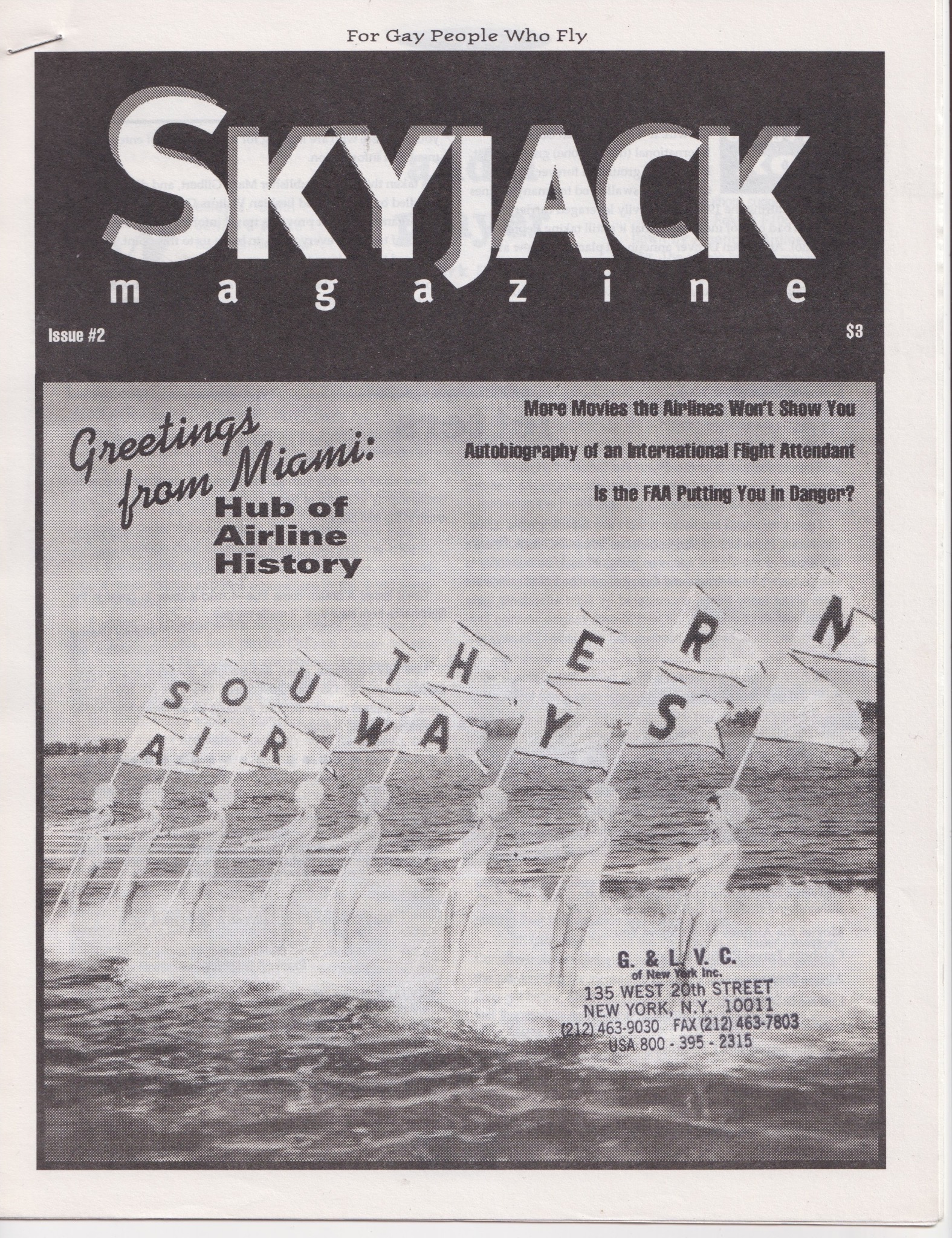
Skyjack Magazine is wheels-up again! Issue 2 (Spring 1994) has officially been digitized — featuring RuPaul at 35,000 feet, Miami’s jet-age ghosts, “movies the airlines won’t show you,” queer aviation art analysis, flight-attendant confessions from both sides of the Atlantic, and all the snarky, sky-high attitude you expect from a 1990s zine for LGBTQ+ people who fly. Scroll down to view the full PDF and enjoy this throwback to the glory days of photocopied rebellion, airline nostalgia, and unapologetic queer travel culture.
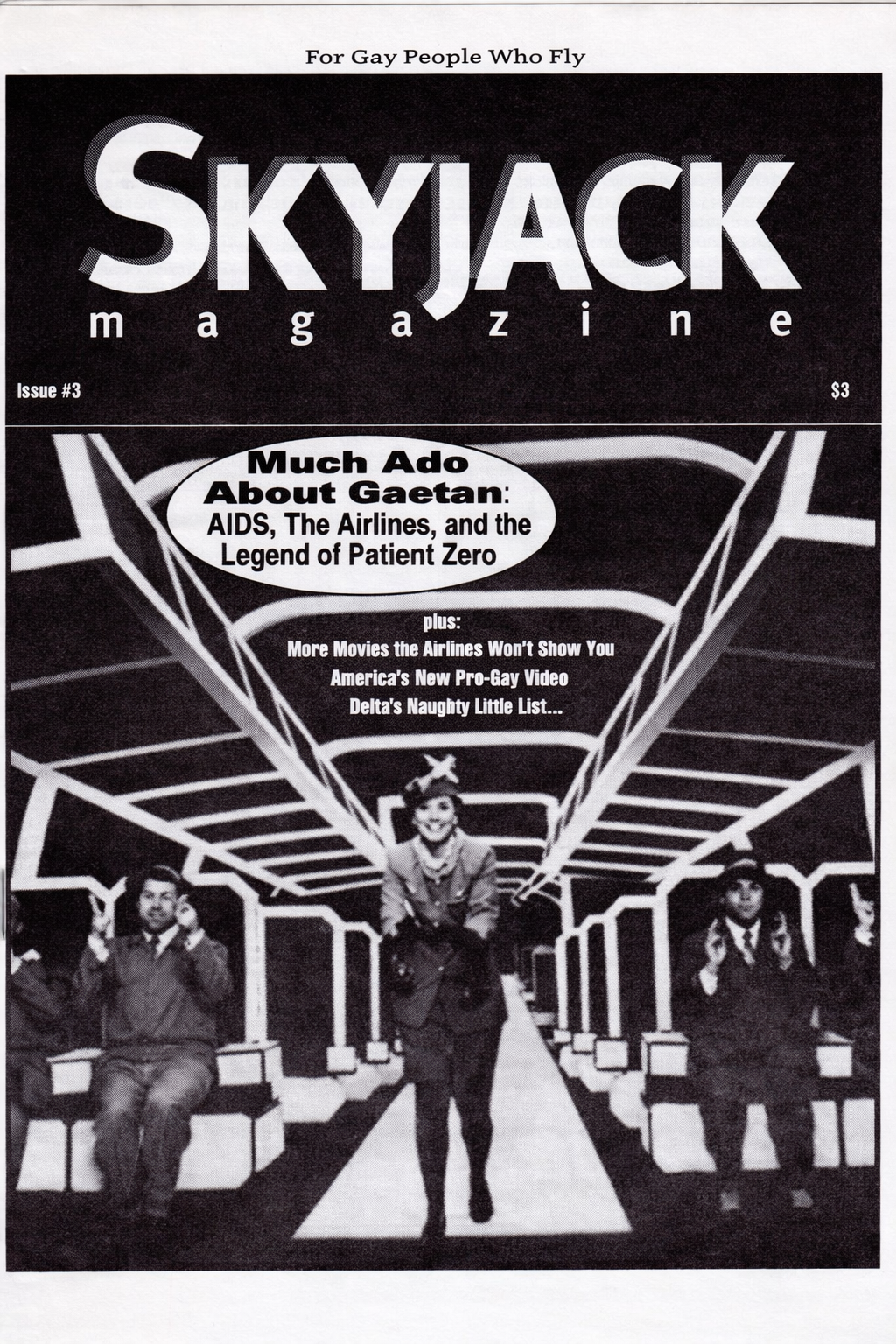
Just as the full Skyjack Magazine archives has been accepted into the prestigious Museum of Flight's collection, Issue 3 (Spring 1994) has officially been digitized — featuring a feature about United's bizarre, "men-only" flights, “more movies the airlines won’t show you,” airlines that took early steps to advertise to LGBTQ+ travelers, and a hard look into the airline industry's attitudes about HIV and AIDS. Scroll down to view the full PDF and be prepared for a trip back in time.
Some publications age like fine wine. Others age like an airline meal discovered beneath a seat cushion. Skyjack Magazine, the LGBTQ+ airline fanzine I founded and managed from 1993 to 1997, has somehow managed to do both: It remains surprisingly relevant while preserving the unmistakable flavor of an era when people booked flights by telephone, met potential partners through classified ads and still regarded an AOL address as suspiciously futuristic.
I’m now sharing the complete PDF of Skyjack Issue 4, originally published in 1994. Even better, the entire 11-issue archive is now part of the permanent collection at Seattle’s Museum of Flight, the world’s largest independent nonprofit air and space museum. That institutional recognition confirms something I certainly didn’t contemplate while pasting columns into layouts and chasing contributors: Skyjack is important historical documentation about corners of airline culture that mainstream aviation media rarely acknowledged. (Departure Level)
The magazine recorded the lives of LGBTQ+ pilots, flight attendants, frequent flyers and airline obsessives at a moment when queer visibility was increasing but workplace protections remained wildly inconsistent. (We also reviewed magnificently bad airline movies — we knew how to have fun, too.)
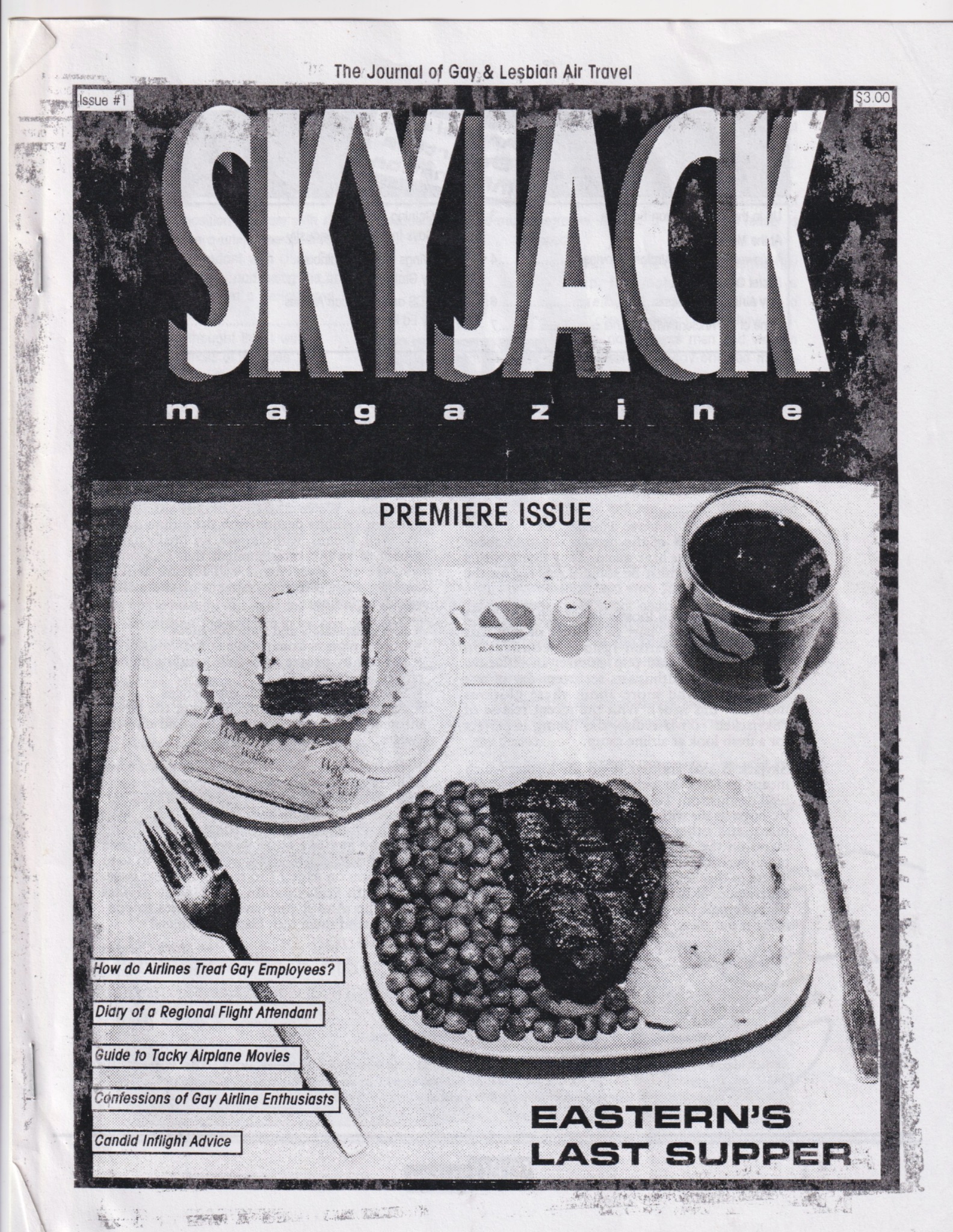
Readers who boarded this digital journey at the beginning may remember that Issue 1 introduced Skyjack as “the fanzine for gay people who fly,” combining airline news, queer culture, Hollywood camp and unabashed aviation nerdery. Issue 2 captured the celebratory energy surrounding Stonewall 25 and showed that the publication was gathering a genuine community. Issue 3 widened the lens further, covering AIDS stigma, discriminatory airline policies, United’s peculiar men-only flights and the printed classifieds that served as a kind of analog Grindr for people with frequent-flyer numbers. (Departure Level)
Issue 4 feels more confident and mature. The humor remains, but the magazine is increasingly comfortable confronting serious subjects without turning into an in-flight safety video narrated by a social worker.
Its centerpiece, “The Closet in the Cockpit,” examines the lives of gay commercial pilots. Writer Byron Cole describes the peculiar balancing act required in an industry where professional respectability, macho traditions and military backgrounds often created pressure to remain closeted. The article includes stories of pilots calculating what to reveal, when to reveal it and how colleagues might respond—sometimes with acceptance, sometimes with ignorance and occasionally with the emotional finesse of a baggage conveyor belt.
A companion piece, “How Do Gay Pilots Cope?,” broadens the discussion through additional firsthand accounts. What stands out today is the isolation. A flight attendant could often find a visible queer network within an airline, but pilots were fewer, more dispersed and working inside a profession that prized discretion almost as highly as seniority. These stories preserve voices that otherwise might never have entered the historical record.
Issue 4 also continues Skyjack’s urgent coverage of HIV and AIDS. “Lessons in Life” recounts the experience of pilots living with HIV, including the anxiety surrounding medical certification, workplace disclosure and the possibility that a diagnosis could abruptly end a career.
The article captures a grim contradiction of the period: Aviation professionals were trained to handle emergencies calmly, yet an HIV diagnosis could create a crisis for which their employers, unions and regulators had no humane checklist. The uncertainty was medical, financial and deeply personal.
Reading it three decades later is sobering. This wasn’t retrospective journalism; these contributors were writing from inside an unfolding epidemic. Skyjack offered space where airline employees could discuss fear, prejudice and survival in their own words—without being transformed into villains, statistics or cautionary tales.
“The Struggle to Fly,” by talented performer and writer Raven Hall, shifts attention to pioneering women aviators, including Harriet Quimby, Ruth Nichols, Helen Richey and Amelia Earhart. The article traces how women repeatedly challenged an industry that treated the cockpit like a private men’s club with wings.
Their obstacles ranged from institutional discrimination to outright sabotage of their ambitions. Yet they continued setting records, flying dangerous routes and proving—again and again—that gender had no bearing on aeronautical competence.
It’s a reminder that queer history and women’s history often share the same departure gate: Both involve talented people being told that established systems simply weren’t designed for them, followed by those people boarding anyway.
This issue also features coverage of the very first “Turbulence,” Skyjack Magazine’s fundraising event, which raised money for Volunteers for AIDS Information and Service, a not-for-profit group run by employees of American Airlines (which provided no financial support for the group). I wish I’d included more photos of the event, which took place at Tunnel club in New York City: Courteous, highly trained drag-queen flight attendants welcomed "passengers" into the festivities, while able-bodied go-go boy baggage handlers offered to check emotional baggage. Door prizes included USAir peanuts (roasted), British Airways amenity kits (fragrant), and books detailing Eastern Airlines fate under Frank Lorenzo (skewered). Turbulence grew even bigger in the coming years.
Elsewhere, Issue 4 crosses the Canadian border to examine workplace discrimination at Air Canada, returns to Hollywood for another round of “More Movies the Airlines Won’t Show You,” follows a flight attendant through an especially eventful trip report and revisits the Lockheed Electra—a beautiful turboprop with a résumé that included some unnerving structural problems.
There are also advertisements, cartoons, industry events, reader awards and wonderfully earnest classified notices. Together, they reveal not just what LGBTQ+ aviation enthusiasts worried about, but how they connected, joked, flirted and built community before social media made everyone permanently reachable and intermittently intolerable.
So settle in and open the complete PDF of Skyjack Magazine Issue 4. It’s funny, candid, occasionally startling and historically significant—a queer aviation time capsule that has finally achieved museum-quality status without losing its Xerox-machine soul.
There are times in every editor’s career when a publication causes a bit of turbulence. Issue 5 of Skyjack Magazine is a perfect example.
I’m continuing my digital excavation of Skyjack, the LGBTQ+ airline fanzine I founded and managed from 1993 to 1997, by sharing the complete PDF of Issue 5. This one was noteworthy for one reason in particular: It was, hands down, the most controversial issue we ever published. It attracted plenty of attention and new subscribers — but it also prompted a couple of subscribers to cancel because they found the subject matter a bit too provocative.
Apparently, even some readers of “the magazine for gay people who fly” had a cruising altitude they preferred not to exceed.
Today, those pages have acquired a different kind of significance. The complete Skyjack archive is now part of the permanent collection of Seattle’s Museum of Flight, the world’s largest independent aviation museum. That’s gratifying because Skyjack documented aspects of airline culture that traditional aviation publications generally ignored: LGBTQ+ employees, queer travelers, workplace discrimination, AIDS, pop culture, sexuality and the wonderfully obsessive subculture of people who find airplanes and airports just as interesting as their final destinations.
My first Skyjack retrospective explained how the magazine began as a DIY labor of love assembled with early desktop publishing, Xerox machines and staplers; by Issue 2, the mix had expanded to include RuPaul, airline history, queer travel and increasingly ambitious cultural reporting. Issue 5 demonstrates just how far that editorial experiment could travel.
And possibly why some passengers decided to disembark.
The cover story, “Cruising at 30,000 Feet,” dives headfirst into a subject that mainstream airline magazines were unlikely to touch: sex on airplanes.
Yes, I took the risky step of investigating the legendary Mile High Club, complete with a chart that details everything from “lavatory lust” and “in-seat iniquity” to cabin crew encounters, concourse cruising and the allure of hunky baggage handlers (wait near the baggage claim and say, “treat me like a Samsonite,” the chart recommends).
This issue was cheeky, deliberately provocative and perhaps a bit much for those two subscribers. But it also reflected something fundamental about Skyjack: We understood that travel isn’t merely transportation. Airports and airplanes are social spaces filled with fantasy, anonymity, possibility and sometimes very human behavior.
Three decades later, that approach also underscores the importance of understanding audiences. Throughout its run, Skyjack spoke simultaneously to aviation enthusiasts, airline employees, LGBTQ+ travelers and people who simply enjoyed watching social conventions and pop culture collide at 35,000 feet.
The “Ionosphere” news section on page 3 provides another type of fascinating time capsule.
One item reports on Virgin Atlantic Airways’ support of the queer press, the incorporation of the National Gay Pilots Association and the growth of the Travel Industry Alliance, an organization that raised funds for AIDSWalk New York — and included members of an American Airlines non-profit group that received fundraising support from Skyjack Magazine’s annual Turbulence event.
Issue 5 continues its fixation on human behavior with “Flying High,” a report by Jay Blotcher that profiles a single gay male flight attendant and his experiences mixing business and pleasure — a personal look at a profession long surrounded by stereotypes. Another piece, “Caught in the Act,” follows a flight attendant who discovers passengers doing exactly what the headline suggests.
For readers seeking something slightly less likely to get the magazine confiscated by a parent, “Fear of Falling…Apart” is a more reflective short story by award-winning writer Lawrence Schimel. And our recurring “More Movies the Airlines Won’t Show You” column tackles the 1986 thriller Night Flight, proving once again that aviation cinema becomes infinitely more entertaining when aircraft are treated as enclosed metal tubes into which filmmakers can insert sex, murder, panic or all three.
Every issue of Skyjack proves that we weren’t trying to be everything to everyone. Skyjack covered airlines through a queer lens with pop culture sensibility, at a moment when few publications were doing anything remotely similar, mixing serious industry issues with sex, humor, nostalgia and unapologetic aviation geekery.
So yes, Issue 5 lost us a couple subscribers.
But more than 30 years later, Skyjack Magazine also landed in a museum.
I’ll take that trade.
Pop quiz: What were the world’s best airlines in the 1990s? Which carrier had the best uniforms? The butchest pilots? And who was the sexiest person in the airline industry?
The voters for the 1995 Skyjack Magazine Awards had very clear opinions about all of that, and more — as you’ll find out in Issue 6 of Skyjack Magazine, the LGBTQ+ airline fanzine, which has just been uploaded and is ready for your reading pleasure.
I founded Skyjack Magazine in 1993 and ran it until 1997. By the time we approached Issue 6, we realized that simply writing about airlines wasn’t enough. We needed to celebrate their fabulousness and their foibles. Rank them. Rate them.
And thus, the Skyjack Magazine Awards were born.
This is the latest issue that I’ve digitized and shared online. Like the previous issues, it’s a wonderfully peculiar snapshot of the decade before social media and the internet changed the landscape.
I’m especially excited to share Skyjack Magazine now, since the entire 11-issue archive has joined the permanent collection at Seattle’s Museum of Flight, the world’s largest independent nonprofit aviation museum. The addition of Skyjack to the museum’s extensive research collection is recognition of something I didn’t fully appreciate while producing it: We were documenting aspects of airline history, LGBTQ+ life and pop culture that mainstream aviation media rarely addressed.
Previous issues chronicled everything from Stonewall-era queer travel and AIDS discrimination to closeted gay pilots, airline advertising aimed at LGBTQ+ travelers — and, in Issue 5, enough discussion of the Mile High Club to cost us a couple subscribers.
Issue 6, published in 1995, demonstrates just how wide the Skyjack lens had become.
The centerpiece of Issue 6 is the 1995 Skyjack Magazine Awards, a lively compilation of praise, complaints and catty comments based on reader votes about the best — and the worst — of the airline industry.
Categories included best airline, best uniforms, best airline food and favorite airport, alongside less conventional honors such as the “Mucho Macho Award” for the airline with the butchest pilots and the “Looking Good Award” for the best-looking airline graphics.
Internationally, Thai Airways took top airline honors as best overall airline. In the United States, American Airlines and Southwest Airlines tied. Delta Air Lines, meanwhile, could perhaps find consolation since it earned the distinction of having America’s butchest pilots.
American and Delta didn’t do as well in the votes for the Merle Norman Award, however — they both ranked as the two airlines most in need of a visual makeover (at the time, they were still sporting decades-old liveries). And the sexiest person in the airline industry? None other than Herb Kelleher at Southwest.
One of Issue 6’s most historically significant articles is “Victory in Israel,” written by Jonathan Danilowitz, an El Al flight attendant who successfully challenged his employer over spousal travel benefits for his male partner.
Danilowitz described a legal battle stretching over years and ultimately reaching Israel’s Supreme Court, which ruled in his favor. Today, this report serves as a reminder of how commonplace discrimination against same-sex couples was in the 20th century — and how individual airline employees helped dismantle it case by case. Skyjack was documenting those victories while they were happening, not reconstructing them decades later.
That immediacy is one reason these old, photocopied pages now feel more valuable than I ever expected.
Issue 6 also returns to one of Skyjack’s favorite subjects: the people actually flying the airplanes. In “First Flight,” pilot Byron Cole recounts his progression from student pilot through airline flying, including the memorable characters and cockpit experiences that accompanied it.
“Beyond the Hype,” meanwhile, examines the ATR turboprop after highly publicized accidents raised questions about icing and safety. Rather than simply joining the panic, the article digs into the aircraft’s history, commuter-airline economics and the technical issues surrounding the crashes — proof that amid all the camp and cruising jokes, Skyjack could indulge in serious aviation issues with just the right amount of geekery.
Throughout its run, Skyjack Magazine loved to examine the representation of air travel in pop culture. In this issue, one of the ongoing sections, “More Movies the Airlines Won’t Show You,” tackles the spectacularly bad “The Concorde: Airport ’79” in this issue. After all, no responsible aviation publication should ignore a movie in which self-proclaimed “big mouth” actress Martha Raye is trapped in a supersonic lavatory and Eddie “Green Acres” Albert finds his butt firmly wedged in a hole aboard the increasingly less glamorous airliner.
One of my favorite articles in this issue is “On the Air, In the Air,” in which writer and pop culture expert Laura Wise takes a witty look at the strange role that the airline industry has played in television sitcoms — from fear of flying tormenting Dorothy on “The Golden Girls” to Lucille Ball taking an inexplicable leave of absence from her bank job to become a stewardess with Carol Burnett.
Issue 6 also looked back at classic moments in airline history. “The End of the Plain Plane” looks back at Braniff International’s revolutionary 1960s reinvention, when advertising executive Mary Wells helped turn an airline into a flying design statement.
Braniff laid on the eye-catching visuals: brightly colored airplanes, Emilio Pucci uniforms and Alexander Girard-designed interiors were all part of the extensive “End of the Plain Plane” refresh. Even decades later, it’s difficult to imagine another U.S. airline embracing visual experimentation with such flair.
Looking back, Issue 6 reminds me why Skyjack still feels worth sharing. This scrappy periodical wasn’t simply an airline fanzine and it wasn’t just an LGBTQ+ publication, either. Skyjack Magazine occupied an uncommon space where aviation, travel, LGBTQ+ life, design, pop culture, workplace politics and humor came together. It was a hub of information and entertainment for airline industry professionals, travelers and airline enthusiasts.
Now, more than 30 years later, this hub provides a window seat for understanding a hard-to-find history.